IonQ 演示 1 kHz 记忆增强量子互连,连接离子阱与金刚石色心
IonQ Demonstrates 1 kHz Memory-Enhanced Quantum Interconnect Connecting Trapped Ions and Diamond Color Centers
IonQ 发布硬件演示结果,在 138Ba+ 离子比特与金刚石纳米光腔中的硅空位(SiV−)量子存储器之间建立了 1.032 kHz(每秒 1032 对)的 heralded 纠缠互连,保真度 87.9%,较此前离子阱基准快四倍。
AI 生成摘要 · 以原文为准
Trapped-ion quantum hardware developer IonQ has published real-world hardware demonstration results establishing a heralded photonic quantum interconnect between a trapped 138Ba+ ion qubit and a solid-state silicon-vacancy (SiV−) quantum memory embedded in a diamond nanophotonic cavity. Operating at an average entanglement rate of 1.032 kHz (1,032 Bell pairs per second) with a state fidelity of 87.9%, the link represents the fastest heralded entanglement rate demonstrated between separate quantum nodes to date, exceeding the previous trapped-ion benchmark by a factor of four. By combining the optical coherence of atomic qubits with the photon-coupling efficiency of cavity-coupled solid-state memories, the heterogeneous architecture resolves a long-standing photon-loss bottleneck in distributed quantum computing networks.
In conventional two-photon heralding networks, independent photon emissions from two separate nodes must be detected simultaneously at a beam splitter, causing the overall entanglement generation success probability to scale quadratically (p2) with per-attempt photon delivery efficiency. The IonQ memory-assisted architecture replaces joint two-photon interference with a single-photon reflection protocol. A 493.5 nm polarization-encoded photon emitted by the 138Ba+ ion undergoes polarization-insensitive quantum frequency conversion (QFC) to 737.45 nm in a Sagnac-configured periodically poled lithium niobate (PPLN) crystal, followed by an unbalanced interferometer basis converter (BC) that maps polarization into early and late time-bins. The time-bin photon is reflected off the SiV− nanophotonic cavity, imprinting the electron spin state of the diamond memory onto the photon. Detection of a single reflected photon in a diagonal polarization basis heralds the creation of an entangled Bell state (|Φ+⟩ = |00⟩ + |11⟩), scaling success linearly (p) with photon collection efficiency.
| [ IonQ Heterogeneous Photonic Interconnect Performance & Subsystem Budget ] | ||
|---|---|---|
| System / Subsystem Parameter | Demonstrated Metric & Error Budget Contribution | Operational & Architectural Function |
| • Heralded Entanglement Rate | • 1.032 kHz (1,032 pairs/sec; 969 µs mean time to success) | • Matches the ~1 ms cycle time of planned fault-tolerant trapped-ion processors. |
| • State Fidelity & Target State | • 87.9% fidelity to |Φ+⟩ Bell state | • Real-time FPGA feedback applies Pauli/phase corrections to normalize heralded states. |
| • Trapped-Ion Node (138Ba+) | • 4.3% infidelity contribution | • NA = 0.75 objective outside vacuum chamber collects 493.5 nm polarization-entangled photons. |
| • Quantum Frequency Conversion | • 2.9% infidelity contribution | • Down-converts 493.5 nm photons to 737.45 nm via 1492.3 nm PPLN Sagnac pump stage. |
| • Diamond Quantum Memory (SiV−) | • 3.9% infidelity contribution; C = 92 cooperativity | • Nanophotonic cavity-coupled single electron/nuclear spin memory in 20 mK dilution refrigerator. |
| • Detection & Photon Loss | • 1.9% infidelity contribution (undetected photons) | • Superconducting nanowire single-photon detectors (SNSPDs) with sub-100 ns signal latency. |
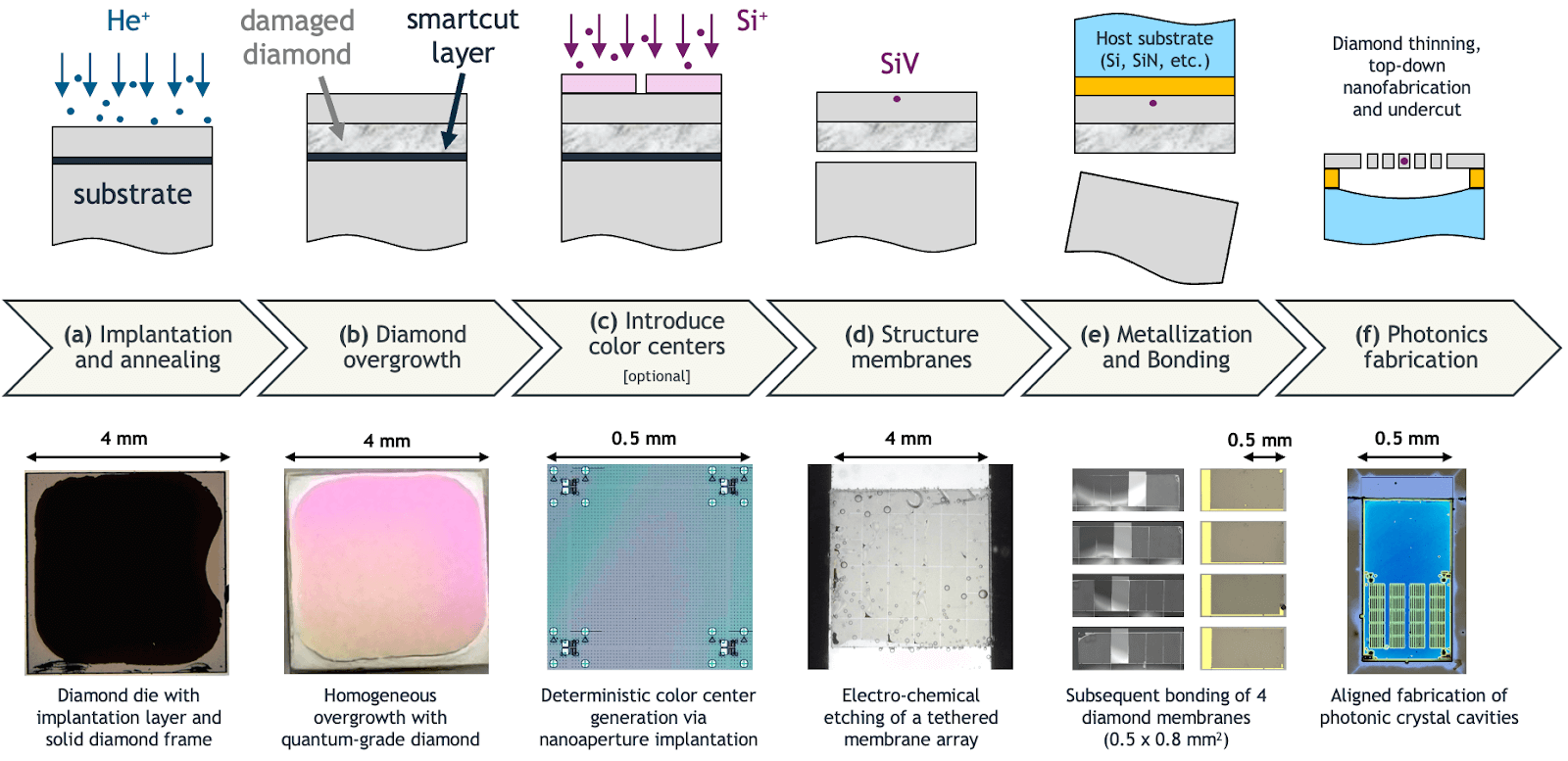
To enable industrial scaling of the solid-state memory layer beyond small-scale academic cleanrooms, IonQ—in collaboration with Element Six and Amazon Web Services (AWS)—developed a foundry-compatible diamond thin-film fabrication pipeline. The platform combines high-energy helium ion implantation, graphitized layer undercutting, homoepitaxial high-purity diamond overgrowth (< 0.2 nm RMS surface roughness), and targeted 28Si+ ion implantation through nanoapertures. Using low-temperature metal thermocompression bonding, arrays of diamond micro-membranes are deterministically transferred onto silicon handling chips or pre-patterned buried coplanar waveguide (bCPW) substrates with near-unity transfer yield. The resulting nanophotonic crystal cavities exhibit high spin-photon cooperativities (C ~ 92–100) and narrow cavity resonance spreads (< 2 nm across membranes), enabling passive optical fiber packaging with sub-decibel insertion loss (< 1 dB).
The kilohertz entanglement milestone advances IonQ’s work under the Defense Advanced Research Projects Agency (DARPA) High-Speed Quantum Interconnects (HARQ) program, which targets QPU-agnostic networking fabrics capable of interfacing trapped ions, neutral atoms, and transduced superconducting circuits. Commercially, the memory-enhanced interconnect hardware builds on IonQ’s recent acquisitions of Lightsynq Technologies and Oxford Ionics, alongside commercial system deployments to the University of Maryland’s QLab and SDT in South Korea.
Review the full news release via the IonQ Newsroom here, inspect the technical physics paper on arXiv here, review the thin-film diamond manufacturing study on arXiv here, read the diamond thin-film platform architecture overview on the IonQ Blog here, and review our previous coverage on IonQ’s selection for the DARPA HARQ program here, IonQ’s expanded quantum networking partnership with the University of Maryland here, and IonQ’s partnership with SDT to establish an SiV quantum memory hub in South Korea here.
In GQI Portal
The players behind the news
The team that writes QCR tracks every company, deal and technology in the GQI Factory, GQI's verified database of the quantum industry. Next up: every story linked to its players, coming to QCR's paid plans.
- Players Companies and institutions across the quantum industry, by segment.
- Scorecards How the players compare on hardware, software, funding and more.
Newsletter
QCR Alerts in your inbox
The latest reporting and analysis from Quantum Computing Report. Free, unsubscribe any time.
来源:Quantum Computing Report · quantumcomputingreport.com