Boston Dynamics 详解重新设计的人形机器人灵巧手
Boston Dynamics gives more insight into its redesigned humanoid hand
The Robot Report 采访 Boston Dynamics Atlas 机器人行为总监 Alberto Rodriguez,介绍其新型四指灵巧手的设计思路。该手具有 13 个自由度,由 13 个完全封装的相同执行器直接驱动,去掉了小指并缩小了夹持器尺寸,仍能搬运超过 100 磅的重物。
AI 生成摘要 · 以原文为准
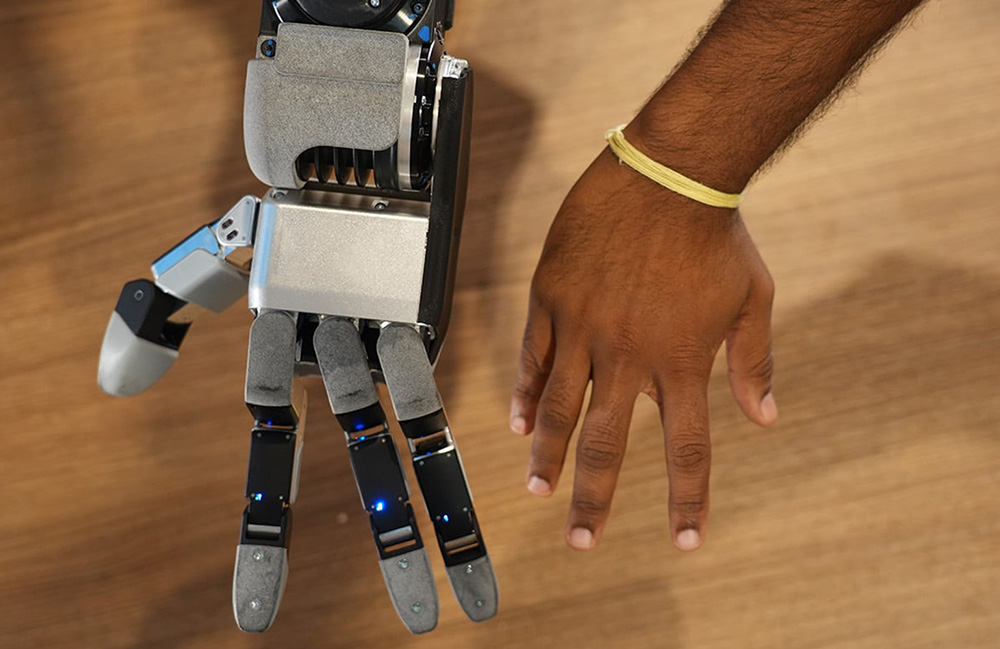
Boston Dynamics said its new hand is still capable of handling over 100 lb. | Source: Boston Dynamics
Last week, Boston Dynamics Inc. gave a look at its new humanoid robot hand. The four-fingered hand has 13 degrees of freedom, or DoF, and is directly actuated. The company said it designed it for mass manufacturing.
Lots of things immediately stand out about the hand. Notably, Boston Dynamics has dropped the pinky finger and reduced the size of the gripper. Less obviously, the company said it built the new hand for high-fidelity simulation to enable sim-to-real reinforcement learning (RL).
To learn more about the new hand, The Robot Report spoke with Alberto Rodriguez, the director of robot behavior for Atlas at Boston Dynamics.
What did Boston Dynamics learn from its humanoid trials that it applied to the new hand?
Rodriguez: Having a product roadmap for Atlas has been a key enabler when it came to making hard decisions like what is the right level of complexity that we should be packing into a hand and navigating its design tradeoff between dexterity, strength, ruggedness, cost, reparability, and sensing.
We have learned things from the design of Atlas’ body. There are things like simplicity, modularity, and actuator maturity that make sense in theory, but over time, you start appreciating the huge impact they have in the velocity you can move.
A reliable robot allows you to capture data faster, run more experiments, and take bets at early deployments. Modularity allows you to focus with more energy on a smaller number of things that you need to get right. That also allows you to move faster.
We have used the same philosophy with this hand. It is built out of 13 identical actuators, all completely encapsulated, with no fragile cables crossing joints, which is already paying off.
We have also learned, for example, that the earlier hands were strong enough to lift 100 lb.-plus heavy objects, so we did not need to increase strength, and we could consider decreasing it a bit to further improve actuation transparency. We also experienced the challenges that earlier hands had with certain more complex tasks, which have influenced the current design.
Did you look at any off-the-shelf end effectors, and why did you decide to build a hand in-house?
Rodriguez: We always look at what is out there to understand the state-of-the-art. Hands are a key piece of technology that are so integral to the value proposition of humanoids that it would be very difficult for us to approach it in any other way than in-house.
As we described in our blog post, all hands come out of a very consequential tradeoff of capabilities, and understanding how it fits into the product roadmap is key.
How does Boston Dynamics ensure durability so the gripper can last through many shifts?
Rodriguez: This isn’t much different from how we do it for other key technologies in the robot.
It all starts from an amazing hardware design team that has done this many times before and has built intuition for what leads to reliable hardware.
We also have a strong culture of collaboration between the behavior and hardware teams in those early design phases to lock in key design features, like morphology, sensing, torque distribution, etc., by using techniques like simulation or mockup designs. This allows the hardware team to go into the detailed design with more confidence.
We build early prototypes and put them in the hands of the systems, controls, and behavior teams for a while to unearth as many as possible of the unknown unknowns and iterate on the design.
Then, we put the hands and various subcomponents through their paces under rigorous validation and verification tests to check that their behavior is at par with expectations. While this is tedious and might initially slow down the deployment of new hardware, it ends up speeding up the process by allowing to refine issues faster than having to painfully discover them in the field.
What kinds of tasks have you been testing with the new hand?
Rodriguez: All kinds. It is difficult to define requirements on a system as complex as a hand, and one way to do it is to build a suite of representative tasks of what the hand is meant to do in the future. Many of these are common industrial tasks like using handheld power tools, handling cables, and fishing for screws.
We have also used these hands on many tasks that are less mission-oriented, such as bring-up tasks that we use to compare against earlier hands, and in other tasks that help us explore the limits of what the hands are capable of.
As always, we like taking inspiration from feats of human physical achievement — such as parkour or gymnastics — to push ourselves and do it in a way that connects with people. We have been playing with different types of juggling and speed hand games.
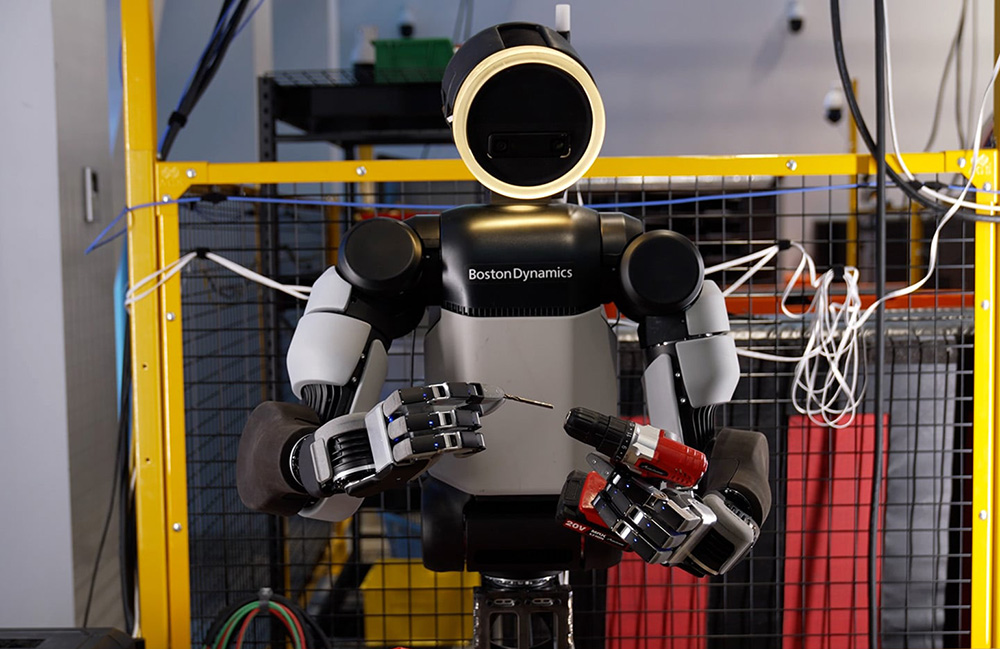
Boston Dynamics said it didn’t set out to build a complicated hand, but instead a reliable one capable of using tools. | Source: Boston Dynamics
Can you tell us more about Boston Dynamics process deciding how many fingers to include on the hand?
Rodriguez: The process relies on intuition, periods of large entropy in concept designs, and then a suite of tasks or behaviors that we wanted the hand to be able to do. Our product roadmap gives us concrete manipulation tasks that we know are in scope for Atlas.
Tool use is an important example, but there are many more, from how small are the screws that Atlas should be able to pick to how small are the spaces where Atlas should be able to put its hands in.
Another useful way to scope hand requirements is as a set of motions that are important for dexterous manipulative behavior, and measure designs against them. Here are some of the key motions that we focused on:
- Being able to slide the fingertip of the thumb along the lengths of the other fingers
- Being able to slide the fingertip of the thumb across the fingers
- Being able to rock the fingertip of the thumb against the index finger in a dexterous pinch grasp
- Being able to exert power grasps on triggered tool handles
Decisions like the number of fingers or the number of joints per finger are difficult, but we try to keep a pragmatic perspective and a clear line of sight to factors like cost and reliability that are key to be able to scale manufacturing.
For example, a design that had a lot of initial support was a hand with two thumbs, one on each side. This design had the added benefit that you do not need to have two separate right and left hands. You can make them on a single assembly line.
We finally decided against it because it involves extra actuation complexity that ultimately incurred extra DoFs, cost, and volume.
What about the hand makes it easier to work with in simulation and for reinforcement learning?
Rodriguez: We design the actuation and transmission with an eye to backdrivability and transparency. On the controls side, we have developed techniques to compensate for some of the remaining non-idealities on the actuators, like compensating for different types of friction.
All of this enables accurate dynamic simulation, key for the design philosophy of the entire robot. This makes reinforcement learning more effective at training policies that can use proprioception, where the actuators themselves sense that you are pushing back on them and transfer directly to hardware.
This is the exact same recipe that has succeeded for agile humanoid behavior in the past few years. Build actuators that simulate well, and then rely on RL at scale.
I am convinced that the ability to use RL in simulation is going to be a key enabler for the next generation of manipulation capabilities for complex dexterity, going beyond pick and place. These are tasks that are difficult to teleoperate or demonstrate, because a lot of the relevant information to reproduce them is in the quick changes of the distribution of contacts and pressure.
Have you started testing the hand at RMAC, and what have the results been so far?
Rodriguez: Not yet. We have used the new hands extensively in our headquarters but have not deployed them yet to the whole robot fleet. That is a process that requires coordination and time to make sure that it does not disrupt regular operations like data collection or applications.
Editor’s note: Brendan Schulman, vice president of policy and government relations at Boston Dynamics, will participate in a panel on “Reshoring With Robots: A Policy Discussion” at RoboBusiness 2026, which will be on Oct. 20 and 21 in Santa Clara, Calif. Register now to attend.
 Register now and help us celebrate 20 years of RoboBusiness!
The post Boston Dynamics gives more insight into its redesigned humanoid hand appeared first on The Robot Report.
来源:The Robot Report · therobotreport.com